
Do You Need an Expansion Tank on a Tankless Water Heater?
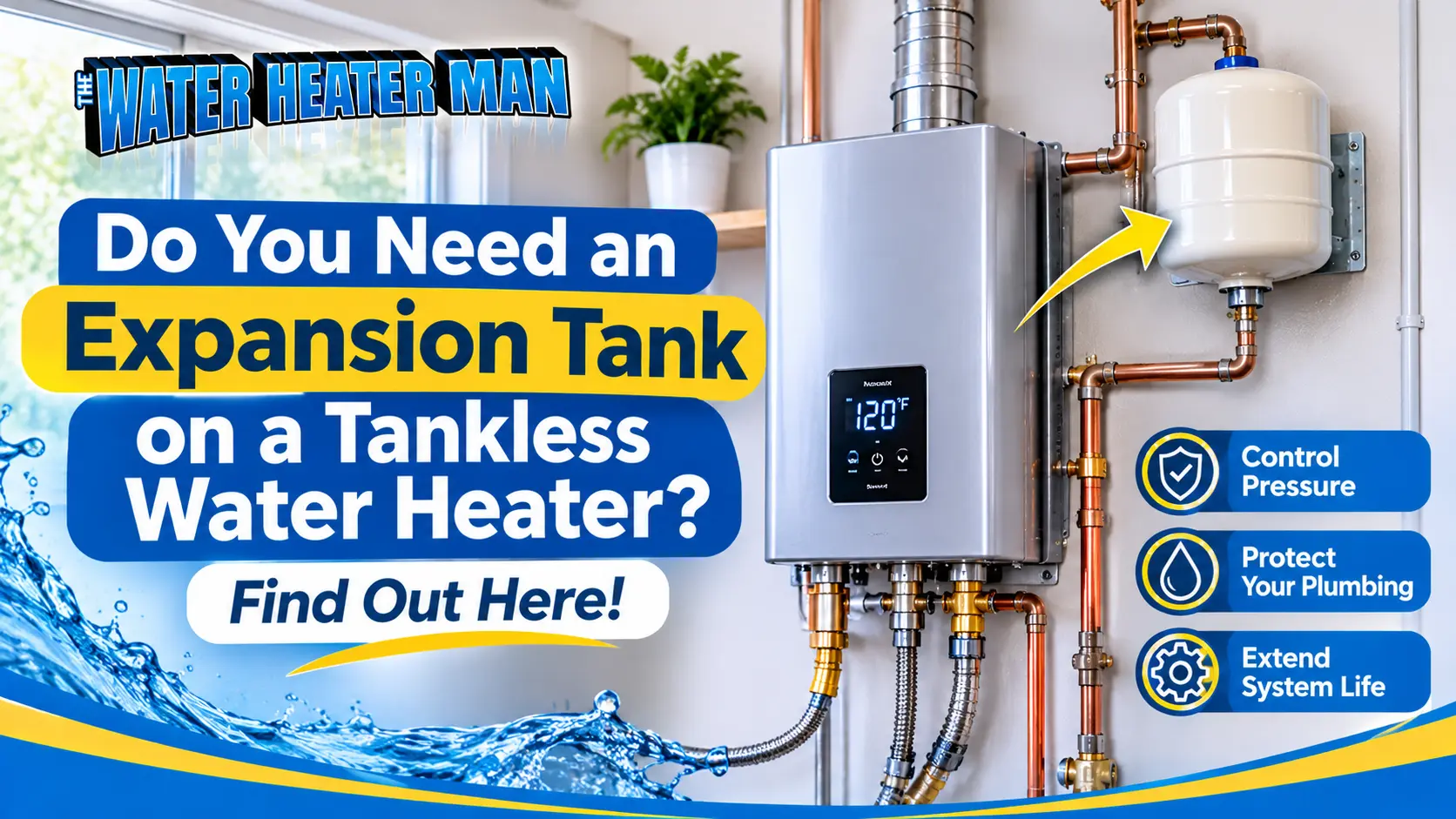
A standard tankless water heater usually doesn’t need an expansion tank because it doesn’t store a large volume of hot water.
But if your home has a closed plumbing system, certain recirculation setups, or specific local code requirements, you may need an expansion tank or another approved device to control pressure.
If you’re installing a new tankless unit or replacing an older water heater, understanding these requirements can help you avoid unnecessary expenses and protect your plumbing. Here’s what homeowners should know before making a decision.
| Get your water heater checked. Schedule Your Appointment! |
What Does an Expansion Tank Do?
An expansion tank is a small, sealed tank that helps manage the extra pressure created when water heats up and expands. It usually contains an air-filled section separated from the water by a flexible membrane.
When heated water expands, the tank gives that extra water somewhere to go. This helps prevent pressure from building up inside a closed plumbing system.
You may have seen a tank installed above or beside a traditional tank water heater. However, an expansion tank can also help protect your home’s plumbing when a closed system prevents expanding water from flowing back into the main supply.
Water expands whenever it’s heated, regardless of the type of water heater. The amount of expansion and the way your plumbing handles it determine whether an expansion tank or another approved device is needed.
Does a Tankless Water Heater Need an Expansion Tank?
Not every tankless water heater needs an expansion tank, but some installations do. Unlike a traditional water heater, a tankless unit doesn’t store a large volume of heated water. So, it usually doesn’t create the same thermal expansion concerns as a storage tank. But your home’s plumbing setup can still require an expansion tank to manage pressure.
| Plumbing Setup | Is an Expansion Tank Needed? |
| Standard tankless system with open plumbing | Usually not |
| Closed plumbing system | May require one or another approved expansion-control device |
| Tankless system with recirculation | Depends on the plumbing setup |
| High incoming water pressure | Pressure regulation is needed; an expansion tank alone won’t fix it |
| Local code requires thermal expansion control | An approved expansion-control method is required |
If a valve prevents water from flowing backward into the public water supply, expanding water can increase pressure inside your home’s pipes.
If your home has a check valve or backflow preventer, water can’t flow back into the main supply when pressure builds up. That’s why California’s plumbing code may require an expansion tank or another way to handle the extra pressure.
But don’t assume you need one just because you have a tankless water heater. You should ask a plumber to check your pipes, look at the manufacturer’s instructions, and see what the local plumbing rules say about your setup.
When Should You Install an Expansion Tank With a Tankless Water Heater?
Whether you need an expansion tank depends on how your plumbing handles the extra volume of heated water. Here are a few situations where it may be necessary.
1. Your Home Has a Closed Plumbing System
A closed plumbing system doesn’t let water flow freely back into the public supply. This can happen when your home has a pressure-reducing valve without a bypass, a check valve, or a backflow preventer.
When water heats up in a closed plumbing system, the extra pressure might have nowhere to escape. This can put a lot of stress on your pipes, so you might need an expansion tank or another approved way to control the pressure.
2. Your Tankless System Uses Hot-Water Recirculation
A recirculation pump keeps hot water moving through the pipes, so you don’t have to wait as long for it to reach the faucet. Some systems also have more valves or a small storage tank.
These added components can change how water moves through the system. Depending on the setup, you may need an expansion tank, but a recirculation pump alone doesn’t make one necessary.
3. Your Home Has High Water Pressure
High water pressure can put extra strain on pipes, faucets, and appliances. If your home’s pressure is above 80 psi, it should be addressed.
An expansion tank alone won’t solve high incoming water pressure on its own. A pressure-reducing valve may be needed, and if that valve creates a closed system, you’ll also need to consider thermal expansion control.
4. Your Local Plumbing Code Requires It
California plumbing rules may require an expansion tank or another way to control pressure in certain closed plumbing systems. What your home needs depends on how the plumbing is set up and the equipment you use.
Ask your plumber to check the installation requirements before the work begins to avoid unexpected costs or problems during inspection.
What Happens If You Skip a Required Expansion Tank?
Leaving out an expansion tank is not necessarily a problem if your system doesn’t require one and has another suitable way to manage pressure. The risk comes from installing a water heater without the necessary expansion control.
Depending on the plumbing setup, excessive pressure can lead to:
- Leaks at plumbing connections: Repeated pressure changes can put stress on fittings and other components.
- Relief valve discharge: Pressure may cause a relief device to release water. Repeated discharge should be investigated rather than ignored.
- Wear on plumbing components: Valves, seals, and fixtures may experience unnecessary stress.
- Inspection or compliance issues: An installation that does not meet applicable code requirements may need corrective work.
| Check your expansion tank requirements. Call 916-215-0030! |
How Do You Know If Your Tankless Water Heater Needs One?
You don’t need to take apart your plumbing to get a useful answer. Start with a few basic checks.
| What to Check | Why Is It Important |
| Pressure-reducing valve | It may prevent expanded water from flowing back toward the supply. |
| Check valve or backflow preventer | These devices can create a closed system. |
| Recirculation setup | Additional pumps, valves, or storage components can change the system’s requirements. |
| Water pressure | High pressure needs attention, whether or not an expansion tank is installed. |
| Installation manual and local code | These establish the requirements for your specific equipment and location. |
A plumber can measure water pressure, inspect the supply line, identify any backflow devices, and review the water heater manufacturer’s instructions. That’s a more reliable approach than buying an expansion tank simply because another home has one.
Can You Install an Expansion Tank on a Tankless Water Heater Yourself?
An expansion tank can be added to a suitable plumbing system, but the work involves more than attaching a small tank to a pipe.
The plumber must choose a tank designed for potable water, size it for the system, set its air pressure correctly, and install it at an appropriate point in the plumbing. The location depends on the system layout and the devices that restrict water flow. The installation must also provide proper support for the tank.
An incorrectly sized or poorly installed expansion tank may not control pressure as intended. It can also place unnecessary strain on the connecting pipes.
If you’re planning a new system, it’s worth addressing expansion control during the original installation. If you already have a tankless heater, a professional can determine whether a tank is needed and whether an existing device is working properly.
Frequently Asked Questions
➢ How often should an expansion tank be replaced?
There isn’t a fixed replacement schedule for every expansion tank. Some last for years, while others wear out sooner. If you notice water around the tank or your plumber finds that it no longer works properly, it may be time for a new one. A quick inspection can help you decide whether it needs replacing.
➢ Why is my water heater’s pressure relief valve releasing water?
A relief valve may discharge because of excessive pressure, overheating, or another problem with the system. Thermal expansion can be one cause, particularly in a closed plumbing system, but it is not the only possibility. Do not cap or disable the valve. Have an experienced plumber check the pressure, expansion-control equipment, and water heater before using the system as usual.
➢ What should I expect to pay for an expansion tank installation?
The price depends on the tank you need and how much plumbing work is involved. If the connections are easy to reach, installation may be fairly simple. If pipes need to be changed or additional parts are required, the cost can be higher. A plumber offering water heater service can look at your setup and provide a more accurate estimate.
Read More!
- How to Test and Replace a Water Heater Expansion Tank
- How Often Should a Tankless Water Heater Be Flushed
- Why Is My Water Heater Leaking?
- 6 Common Tankless Water-Heater Problems and Solutions
Takeaway
Not sure whether your tankless water heater needs an expansion tank? Don’t buy one just because you thought you needed one or someone suggested it. Have your plumbing checked first, so you spend money only on what your system actually needs.
| Need expansion tank assistance? Call 916-215-0030! |
Get the Right Water Heater Solution With The Water Heater Man
Need help with tankless water heater installations or looking for dependable water heater repair in Roseville? The Water Heater Man can help.
With more than 25 years of experience, we have been serving homeowners in Roseville and surrounding Greater Sacramento communities.
The Water Heater Man is a fully licensed (#641126), bonded, and insured company, and our services include:
- water heater repair
- water heater replacement
- new water heater installation
- water heater maintenance
- tankless water heater services
Our owner, Jay, personally connects with each customer and can assess your system, explain the available options, and help you keep your hot water running reliably.
Call Jay at 916-215-0030 to schedule your same-day water heater service in Roseville today!
Serving Our Clients Throughout the Greater Sacramento Area
The Water Heater Man serves homeowners across the Greater Sacramento area, including the following communities.
| Rocklin | Roseville | Granite Bay | Lincoln |